
Before — protect the array
Act now while you have a choice
- Installation can be booked and completed
- No legal delays — no waiting on eggs or chicks
- One-off cost from £350, fully installed
- Protects the array for years
- No insurance issue, no legal risk
The case for acting now
Once a bird builds a nest under your solar panels, UK law means you cannot touch it. You wait — sometimes for months — while the damage continues. The only practical answer is to protect the array before nesting begins.
UK wildlife law
The Wildlife & Countryside Act 1981 gives full legal protection to all wild birds, their nests and their eggs. This is not a guideline — it is a criminal offence carrying an unlimited fine.
In practice this means: if a pigeon builds a nest under your solar panels, and that nest contains eggs or chicks, no one can legally remove or disturb it— not PVDEFEND, not a pest controller, not the homeowner. The work stops. You wait until the chicks fledge and the nest is confirmed empty.
Pigeons can breed year-round in mild UK conditions. That means a nest discovered in spring could mean waiting until late summer before any protection can be fitted — months of accumulating damage while your hands are legally tied.
Source: Wildlife & Countryside Act 1981; Natural England guidance on wild bird protection; industry guidance from GreenHat Renewables.
Why timing is everything
Before — protect the array
After — legally stuck
Don't wait for visible damage. The time to protect is before nesting season — or as soon as you know the array is unprotected.
What nesting birds actually cause
This isn't about being unkind to birds. It's about the physical, financial and legal consequences of leaving a gap under a solar array unprotected.
Bird fouling on panel glass blocks sunlight reaching the cells. Even partial soiling can reduce local output by 20–30%, translating to around 5–15% lower annual energy yield across the whole array. Hotspots caused by uneven shading can further degrade panels over time.
Nest material — twigs, straw, feathers, debris — accumulates under the panels and spills into gutters. This clogs drainage and can cause water to pond and overflow. Uric acid in bird droppings is corrosive and accelerates wear on tiles, gutters and any metal rail beneath.
Dry nesting material collects around warm electrical cables and inverter junctions. An arcing fault or overheating cable in a thick nest can start a roof fire. This risk is well documented by installers and safety organisations. It is one of the most serious consequences of leaving an array unprotected.
Corvids and rodents sometimes chew rubber cable insulation and panel sealants. This can cause short circuits or DC isolation faults requiring a qualified electrician and potentially a new inverter. Even non-catastrophic wiring damage means downtime and maintenance costs.
Trapped debris under panels retains moisture. Combined with the corrosive effect of droppings on tiles and flashing, long-term bird activity can accelerate deterioration of the roof covering beneath and around the array — adding to the cost of any eventual repair or replacement.
Nesting pigeons are active from dawn. Dried droppings can contain fungal spores including Cryptococcus and Aspergillus. Disturbing old nests during any maintenance requires appropriate PPE. A large accumulation of nest material can also be an unpleasant sight and smell for the household.
Insurance reality
Most standard home insurance policies explicitly exclude damage caused by pests or wildlife — including bird infestations. This means that if a nest under your solar panels causes a gutter to fail, a tile to crack, or — worst case — a roof fire, the repair bill lands entirely on you.
Bird-proofing is not a nice-to-have. It is a preventative measure that sits between your solar investment and a repair bill your insurer will decline to cover.
Cost comparison
Bird-proofing installed: from £350
Gutter repair & clearance: £200–£600+
Tile or roof repair: £400–£1,500+
Inverter fault / wiring repair: £500–£2,000+
Roof fire remediation: many thousands
None of the above likely covered by standard home insurance where the cause is wildlife or pest activity.
Best time to act
Most UK bird species complete nesting by late August. September to February is the ideal window: nests are legally empty and installation can proceed without delay.
This is when PVDEFEND recommends installation. No active nests, no legal risk, no waiting. We inspect before starting and clear any empty, abandoned material as part of the job.
Even outside this window, if an inspection confirms no active nesting, we can proceed. We will never guess — we check first.
Many songbird species nest through spring and into summer. Pigeons can breed almost any month in mild conditions. An active nest discovered during a planned installation means the job pauses until the nest is legally empty.
This isn't an inconvenience — it could mean several months' delay while your unprotected array continues to accumulate debris and exposure.
Book now. Don't find yourself on the wrong side of nesting season.
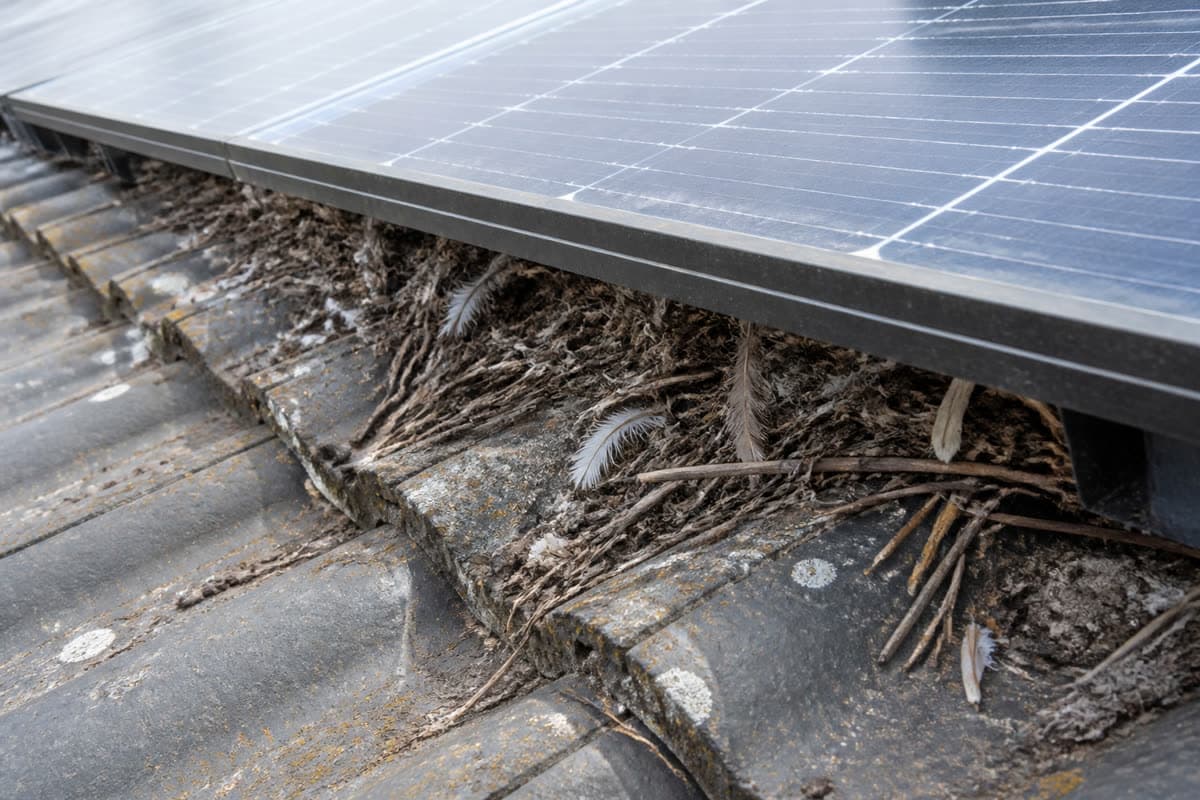
This is what unprotected panels can look like. Nesting material, debris and fouling accumulate over time — and once a nest is active, UK law requires you to leave it.
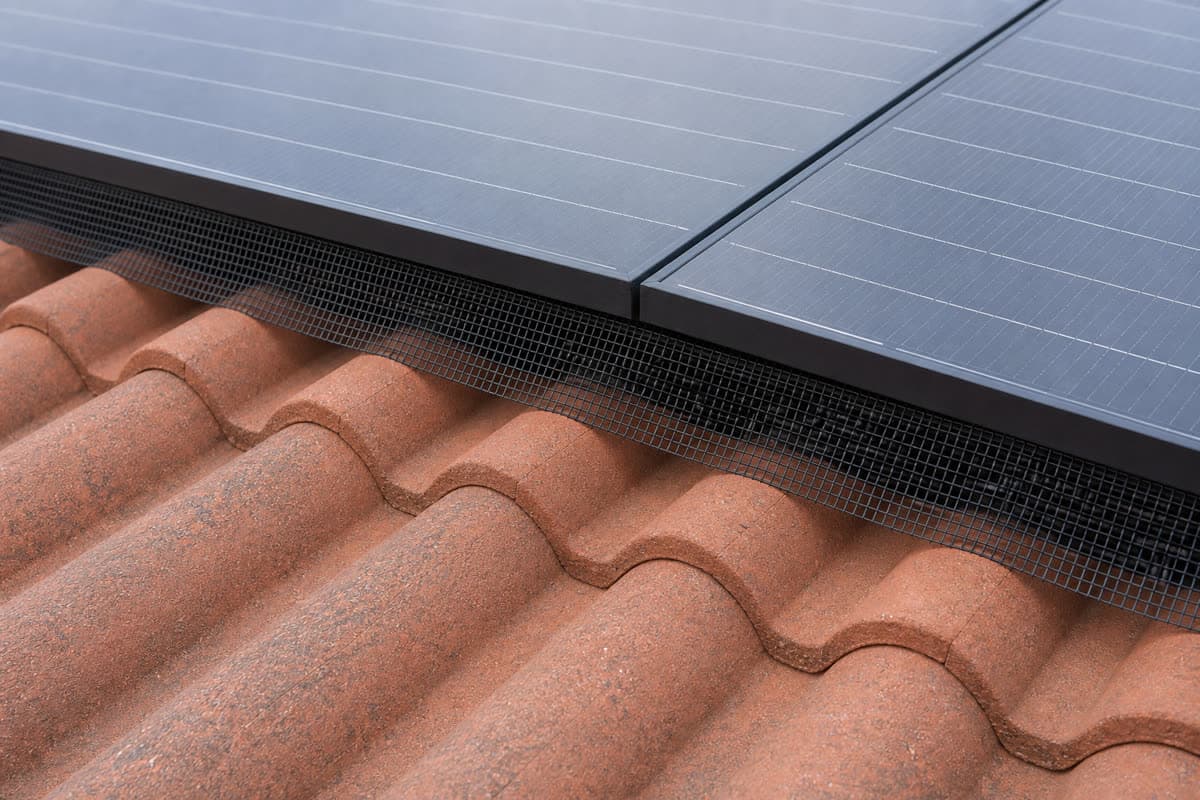
The same style of array with professional bird-protection mesh. Discrete, durable, fitted without drilling into the panels.
Your questions answered
Not if the nest is active. Under the Wildlife & Countryside Act 1981 it is a criminal offence to disturb, damage or destroy the nest of any wild bird while it is in use or being built. If eggs or chicks are present, work must stop until the nest is empty — which may mean waiting several months.
The safest window is September to February, after the main nesting season ends in late August. Some species, including pigeons, can breed year-round in mild conditions, so a pre-installation inspection is always carried out. We will not start work if a live nest is present.
Debris accumulates, gutters block, fouling on the glass reduces output, dry nesting material creates an increased fire risk around wiring, and the repair bill grows. Most home insurance policies exclude damage caused by wildlife, so the cost falls on the homeowner.
Most standard home insurance policies explicitly exclude damage caused by pests or wildlife, including bird infestations. Any repair costs from a leak, fire or gutter failure linked to nesting would typically not be covered.
Professional systems use solar-appropriate fixings — clips that attach to the panel frame rather than drilling into the glass. This is the established method for preserving panel warranties. We still recommend checking your original manufacturer's requirements before installation.
Don't wait for the damage to start
The free check is no-obligation. We inspect the array, confirm whether protection is recommended and give you a clear price — before a single bird has settled.